We've accidentally made buying clothes boring
Here's something that should bother anyone who works in fashion ecommerce. We've taken one of the most enjoyable things a human being can do with their afternoon, buying themselves something lovely to wear, and turned it into something that feels like renewing car insurance (no offense car insurance). Grid of products. Filter. Sort. Add to basket. Enter card number. Done. Go away now.
Nobody decided to do this on purpose. It just sort of happened. We got really good at making ecommerce functional and forgot to make it fun. The checkout works. The search works. The filters work. Everything works. It's just that nobody's having a good time.
UK fashion ecommerce hit around £21 billion in 2025 according to EMARKETER, and nearly half of all clothing spend in the UK now happens online according to Mintel's 2025 report. That's an astonishing amount of money flowing through experiences that give you roughly the same emotional thrill as a dentist appointment. There's something not right about that.
What actually happens in a good shop
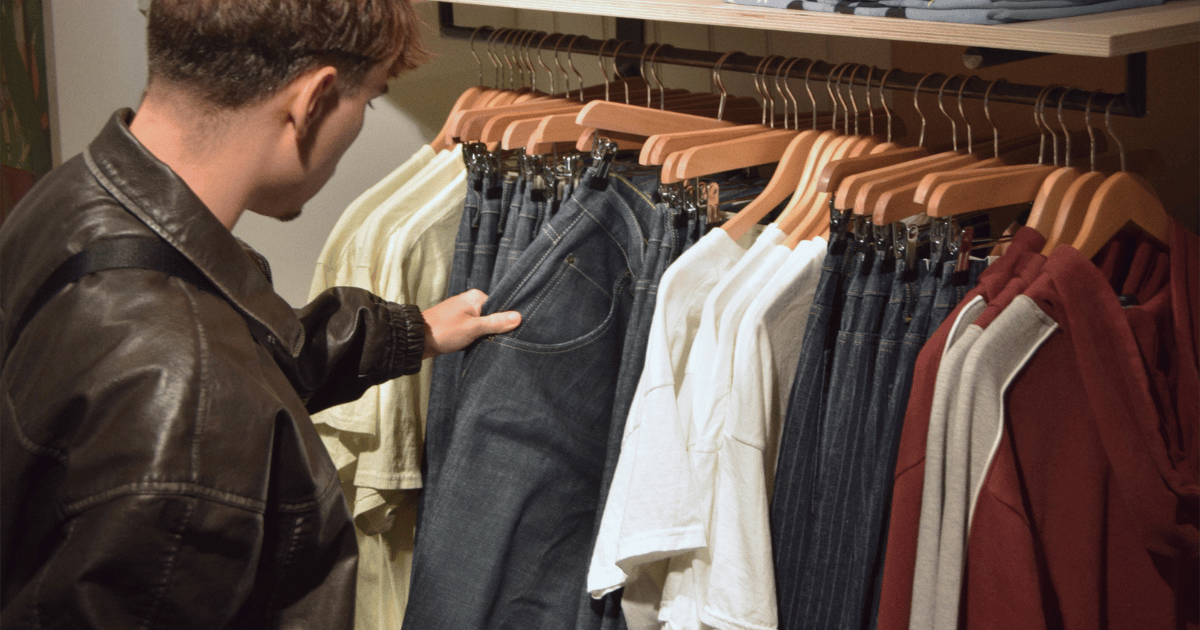
Think about the last time you had a properly good time shopping for clothes in person. Not a stressed lunch break dash to Primark, but an actual enjoyable browse. You touched things. You held stuff up and went "ooh." You wandered into a section you weren't planning to visit and found something unexpected. Maybe you tried something on that you'd never normally go for and you looked absolutely tremendous. You are looking smashing by the way. Have you done something with your hair? I love it.
That experience is doing loads of heavy lifting that we don't consciously notice. You're getting information about fabric weight and texture through your hands. You're building an instinctive sense of quality. The difference between a well-made coat and a coat that'll fall apart after six washes is immediately obvious when you can touch it. Online, those two coats look identical. Same photo, same white background, same little zoom-in that shows you absolutely nothing useful about how the fabric actually behaves in the real world.
You're also comparing things spatially, holding one jacket next to another and making decisions that would take you fifteen minutes of tabbing between browser windows to replicate. Your brain is brilliant at processing visual comparisons when it can see things side by side. It's absolutely terrible at it when it has to remember what something looked like three clicks ago. And yet that's the experience we've built for people. "Just remember what the other one looked like, yeah? You'll be fine."
And crucially, you're enjoying yourself. You're in discovery mode, not transaction mode. You're open to surprise. You're willing to try something you wouldn't normally go for. That's where the best purchases come from, the ones where you walk out of a shop buzzing because you found something you didn't know you wanted.
Online, we've kept the transaction bit and binned the rest. We've made it very easy to buy something, but we haven't done nearly enough to help you fall in love with it first. And that matters, because when people don't have enough information or enough emotional connection to feel confident in a purchase, they hedge. They order three sizes. They buy two colours. They bracket, fully intending to send most of it back. If it's too expensive to buy multiple sizes, they don't buy at all.
Fashion return rates sit around 25 to 30% for online purchases in the UK, according to data from the British Fashion Council and the National Retail Federation. Size and fit issues alone account for roughly two thirds of those. People aren't misbehaving or being difficult. What you see there is people being rational in the face of an experience that doesn't give them what they need to decide properly.
So what do you actually do about it?
I've worked with a premium haircare brand and a premium fashion retailer on exactly this problem, and the starting question is always the same: what does your customer lose by shopping online, and what do they gain?
The losses are obvious in fashion. You lose touch. Literally. You can't feel the weight of a coat or the softness of a knit. You lose fit confidence, because no size chart in the world replicates the experience of actually putting something on your body. You lose easy comparison, that thing where you hold two items side by side and your brain just goes "that one" without needing a pros and cons list. You lose the mate who looks at you and goes "absolutely not, take it off." (Cheers Alex)
But you gain things too, and this is the bit that most fashion ecommerce doesn't shout about nearly enough. You gain access to everything, not just whatever your local store happened to get in this season. You gain the collective wisdom of thousands of other customers who've actually worn the thing and can tell you whether it runs small. You gain time to think without a sales assistant materialising at your elbow asking if you're finding everything okay. Yes mate, I'm finding everything fine, I know you're doing your job buddy but please leave me alone, I do not wish to be observed. I'm browsing.
The trick is simulating what's lost and cranking up what's gained. For the haircare brand, that meant highlighting things you genuinely couldn't get anywhere else. Personalised engraving. Easy comparison between products. Cross-selling complementary stuff like sprays and styling products. Gifting options. Limited edition launches that only existed on the website. The site wasn't only one of many possible shops. It was the best possible place to buy their products, better than Amazon, better than a department store, and the experience needed to make that obvious.
For the fashion retailer, the challenge was different. These were premium pieces with serious price tags. You had to convince someone that a £300 jacket wasn't just a jacket, it was an investment piece that'd become a staple of their wardrobe for years. That's a completely different emotional job to just showing someone a photo and a price and hoping for the best. We improved the overall ecommerce experience to better showcase the product, to communicate quality and longevity and craftsmanship in a way that justified the spend.
The comparison problem
Here's a tricky one. I've worked with brand teams who genuinely believed that all their products were equally suitable for all their customers. "Everything in our range is perfect for everyone." That's a lovely thing to put in a brand guidelines document. It is completely useless to someone standing in your virtual store trying to work out which of your seven moisturisers is right for their actual face.
Customers can see that your products are different. They've got different names, different packaging, different prices. When you refuse to help them understand how they're different, you're not protecting the brand but creating confusion. And confused people do one of two things: they leave, or they guess wrong and regret it.
The brands getting this right treat comparison as a service, not a threat. They actively help customers narrow down options based on what they actually need. "Got thick, coarse hair? This one. Fine hair that goes flat by lunchtime? That one." It's more honest, it's more helpful, and it consistently converts better because people buy with confidence instead of buying with crossed fingers.
I get why brand teams resist this. Nobody wants to say "this product is less suitable for you" because it feels like you're talking a customer out of a sale. But you're not. You're talking them into the right sale. The one they keep. The one that makes them feel like your brand actually understands them. That's worth ten confused purchases that come back in a jiffy bag two weeks later.
This connects to something I feel strongly about. Deceptive patterns in fashion, the urgency timers, the "only 2 left!" warnings, the guilt-trippy basket abandonment emails, they might push someone into a quick purchase. But when the product arrives and it's wrong, you've created a return, a negative experience, and someone who's less likely to come back. Helping someone make a genuinely good decision is slower, but it sticks. The customer keeps the product, wears it, loves it, tells their mates about it, and comes back for more. That's ethically better and it's commercially better, as nobody needs the "hard sell" when the product is actually right for them.

What the best fashion sites are doing differently
The fashion ecommerce playbook hasn't really evolved in a decade. Product grid, filter sidebar, product detail page, size chart, add to basket. That's table stakes now, not a competitive advantage.
The brands I've seen make real progress are doing a few things differently. They're treating product discovery as something closer to entertainment than administration. Browsing their sites feels a bit like flicking through a really good magazine rather than scrolling through an Excel spreadsheet. Editorial content woven through the shopping experience. Curated collections that tell a story. Visual merchandising that draws you through the site rather than just dumping everything in front of you and going "there you go, good luck."
They're investing seriously in reducing size uncertainty, because it's the single biggest driver of returns. Size charts are the bare minimum. The ones making real headway are using detailed fit notes ("runs small, size up"), model reference info (height, build, size worn), and increasingly AR try-on tools. Every percentage point reduction in size-related returns drops straight to the margin. It's not much but it's honest (and extraordinarily profitable) work.
They're showing products in context. A flat-lay photograph on a white background tells you what a garment looks like. A styled photo tells you what it looks like on a real human being, in a real setting, as part of a real outfit. When McKinsey's research shows 75% of consumers are trading down for better value, the products that sell are the ones that communicate their worth through context. You need to see the jacket on someone who looks like they're having a tremendous time wearing it, not pinned to a headless mannequin under fluorescent lighting like it's been arrested. (What would a mannequin get arrested for? Loitering I expect)
And they're using social proof properly. Reviews in fashion are the digital equivalent of the fitting room friend. The one who says "that looks brilliant" or "honestly, the colour's not doing you any favours." Review content that addresses fit, styling, and durability does more work than any amount of brand copy. "I'm a size 14 and this runs a bit small." "Looks amazing with dark jeans." "Worn it twenty times and it still looks new." That's the stuff that gets people over the line. The brands winning here treat their review sections as editorial content, curating and surfacing the most useful contributions rather than just slapping a star rating at the top and calling it done.
There's also something to be said for making the whole thing feel less like a database query. Most fashion sites are structured around the assumption that you know what you want before you arrive. Category. Subcategory. Filter. Results. But loads of fashion shopping, the fun kind, starts with "I fancy something new" rather than "I require a navy crew neck jumper in medium." The sites that capture that browsing energy, through editorial content, outfit inspiration, styled lookbooks, and "new in" sections that actually feel curated rather than algorithmically generated, are the ones that keep people exploring rather than bouncing after thirty seconds because they didn't find exactly what they typed into the search bar.
The bigger picture
There's a sustainability angle here that's worth mentioning, not because it's trendy but because it's real. The environmental cost of shipping a product to someone, having them try it on in their bedroom, repackaging it, shipping it back, inspecting it, and restocking or disposing of it is properly significant. Processing a single return can cost anywhere from 20% to 65% of the item's original value according to Shopify's 2025 analysis. Multiply that across an industry where nearly a third of online purchases come back and you start to understand why CFOs get a bit twitchy around January.
Extended Producer Responsibility legislation is heading for fashion textiles in the UK, and the era of treating returns as a free, frictionless thing is ending. Some retailers have already started charging for returns, which is one way to address the problem. But it's addressing the symptom rather than the cause. Charging people to return things they bought in good faith because your site didn't give them enough information to choose correctly is not a great look. It's a bit like a restaurant charging you extra because the menu was misleading. Fix the menu.
Reducing returns by building better digital experiences is good business and it's good for the planet, and it's good for the customer who'd rather have got it right the first time than mess about with a returns label and a trip to the Post Office. Its one of those rare and beautiful situations where the ethical thing, the commercial thing, and the environmental thing are all the same thing. You don't get many of those. Enjoy it.
Getting started
If you're working in fashion or retail ecommerce and any of this resonated, the starting point is understanding your specific experience gap. What are your customers losing by shopping with you online? What are they gaining? And are you actively making the most of those gains while closing the gap on the losses?
At Another Web is Possible, we help fashion and retail brands work this out through ethical experimentation and genuine user research. No deceptive patterns, no manipulation, no urgency countdowns. Just figuring out how to make your site a good place to shop, so people buy the right thing the first time and come back because they enjoyed the experience.
Buying online should feel like something worth doing. Not like paying a water bill.
Another Web is Possible, if we want it.
Sources
- EMARKETER, "The State of UK Fashion Ecommerce 2025," emarketer.com
- Mintel, "UK Clothing Retail Market Intelligence Report 2025," store.mintel.com
- National Retail Federation / Happy Returns, "Consumer Returns in the Retail Industry 2024," nrf.com
- British Fashion Council, UK online apparel return rates data
- McKinsey & Company, "Consumer Sentiment Survey 2024"
- Shopify, "Ecommerce Returns: Average Return Rate and How to Reduce It," 2025